BUYING & FINANCE
What Happens at the Settlement Table — A Minute-by-Minute Walkthrough
A minute-by-minute walkthrough of the Japanese property settlement meeting — who's there, what's handed over, and what to watch for.
On this page 8
TL;DR: The settlement meeting is a single session, usually 1–2 hours, at which the buyer transfers funds, the seller hands over all keys and ownership documents, and the judicial scrivener executes the registration paperwork. Nothing is casual about it. Every person at that table has a specific role, and the sequence is deliberate.
I’ve sat at enough settlement tables to notice what first-timers do. They walk in anxious but unfocused — worried about the wrong things, unprepared for the moments that matter.
The settlement meeting is not a formality. It’s the moment of transfer. It runs on a rhythm that, once you understand it, is reassuring. Here’s the full walkthrough.
Who’s actually in the room?
The cast varies slightly, but typically:
Buyer — that’s you. Bring your passport, alien registration card or residence card if you have one, personal seal as required, and any documents your agent pre-specified.
Seller — required in person. If the seller is a corporation, an authorized representative with proof of authority attends.
Buyer’s agent — coordinates the meeting, handles final fee calculations, facilitates document flow.
Seller’s agent — may be the same person as the buyer’s agent in dual-agency situations.
Judicial Scrivener — often the most important person in the room, though the least known to foreign buyers. They verify all ownership documents, confirm identities, and are the only person who can submit the ownership transfer to the Legal Affairs Bureau.
Bank representative — present if the buyer is financing the purchase. They manage loan disbursement and collect the bank’s security documents for mortgage registration.
Location is almost always the bank’s meeting room when there’s a loan involved. Cash transactions may be held at an agent’s office or a notary office.
From the desk — After years of sitting at these settlement tables, the moment I brace for is never the money transfer, it is the key handover, because that is where the small things surface. The pattern I see again and again is a buyer nodding along, accepting a key ring, then discovering weeks later there was no key for the basement storage or the bicycle area, and by then it is their problem to chase. I now physically count keys against the listing at the table every single time, and I have stopped apologizing for the thirty seconds it takes.
What happens in the first 20 minutes?
The meeting opens with identity verification. The judicial scrivener checks everyone’s documents with methodical care.
For the seller: they verify the ownership identification document — essentially proof that the seller legally owns what they’re selling — the seller’s seal registration certificate, and a document confirming the seller’s identity matches the registered owner.
For the buyer: passport, and any Japan-registered identification. If the buyer has a Japanese personal seal, the seal certificate is checked here too.
This phase feels slow. The judicial scrivener is protecting everyone at the table from ownership fraud. Japanese real estate scams, when they occur, often target this exact verification point. Let it take the time it needs.
When does money actually move?
After identity verification is complete and the judicial scrivener confirms the documents are in order, the bank disbursement happens.
For financed purchases: the bank confirms the loan amount is disbursed into a designated account. The buyer may sign the final loan agreement documents at this point if not done in advance.
For cash purchases: the buyer has pre-arranged a wire transfer timed to arrive in a designated account on settlement day. The bank (or notary, depending on setup) confirms receipt before the process continues.
The seller’s existing mortgage, if any, is paid off directly at this point — the judicial scrivener ensures the payoff amount goes to the right lender before the seller receives any net proceeds.
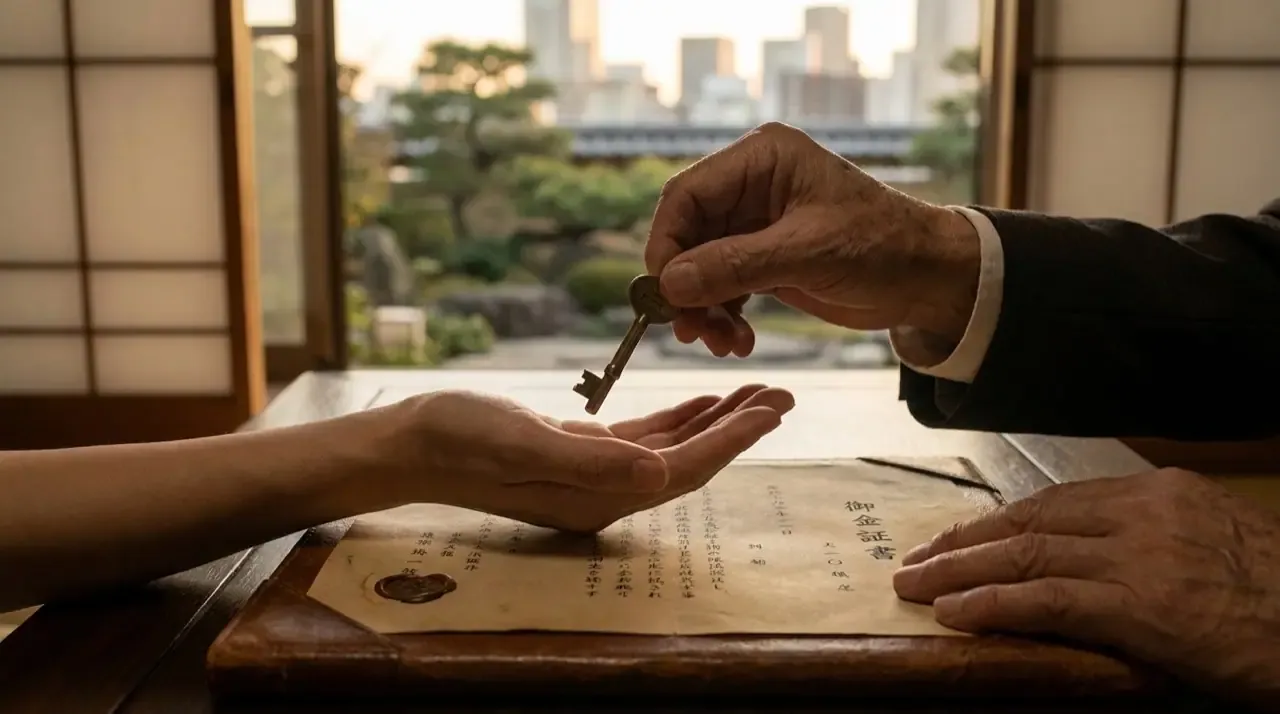
Once funds are confirmed received, the seller hands over:
- All physical keys (building entrance, apartment door, mailbox, storage, bicycle parking — count them)
- Management rules and usage regulations for condominiums
- Any appliance manuals or warranty cards being left with the property
- Building inspection report if one was conducted
- Utility account information for transfer
What are the judicial scriveners actually doing during all this?
While keys change hands and the mood softens, the judicial scrivener is completing the most consequential part of the meeting.
They’ve already verified the owner registration is current and that no new liens or encumbrances appeared between contract signing and today. This is a same-day check against the live registry. If anything has changed, the judicial scrivener can stop the transaction. This almost never happens, but it’s why they check.
They’re also preparing the ownership transfer application. This document, once submitted to the Legal Affairs Bureau, is what actually makes you the legal owner of record. The judicial scrivener submits it the same day as settlement, or the next business day.
You’ll sign a power of attorney authorizing the judicial scrivener to submit the registration on your behalf. Standard.
What documents get signed at the table?
More than you expect. Typical signing requirements include:
- Final confirmation of the purchase price and adjustment breakdown (prorated management fees, fixed asset tax adjustments, any prepaid items)
- Receipt acknowledgment for keys and handover documents
- Power of attorney to the judicial scrivener for registration
- Loan agreement and bank security documents (if financing)
- Various administrative forms depending on the property type and municipality
Your agent should have given you a pre-settlement briefing on what to sign. If they didn’t, ask for it the day before.
Bring a black pen. Bring your stamp if you have one. Don’t bring the wrong version of any document — confirm the checklist with your agent 48 hours in advance.
What happens after the meeting ends?
You leave with keys. You do not yet leave with legal ownership. That happens when registration completes.
The judicial scrivener submits the transfer application same day. The Legal Affairs Bureau processes it, typically within 1–2 weeks. After completion, you receive the registered certificate of title — the official proof of ownership you’ll use for everything from future sales to tax filings.
For financed purchases: the bank registers a mortgage on the property simultaneously. You’ll see this on the registration certificate alongside your name.
Final fee payments happen at or just after settlement: agent commissions, judicial scrivener fees, and remaining stamp duties. Yo
Related reading: Buy Tokyo Property on a Work Visa: An Agent’s Honest Guide.
ur agent will have calculated these precisely in advance.
Where this goes wrong
-
International wire transfers arrive late. Settlement is time-stamped. If your funds don’t clear in the designated account by the time the meeting runs, the settlement can’t proceed. Wire from your foreign bank at least 3–5 business days early, accounting for weekend holds and bank processing time.
-
Buyers don’t count the keys. Sounds minor. A missing basement storage key becomes your problem after settlement. Count them at the table.
-
The final fee adjustment calculation surprises buyers. Fixed asset tax is prorated from settlement date to year-end. You may owe the seller several months of prepaid tax. Verify the breakdown at the table.
-
Buyers don’t confirm what condition the property is in before attending. If you negotiated repairs or cleaning, confirm completion before settlement day — not at the table. Remedies after settlement are much harder to enforce.
-
Nobody brings a translation of the key documents. Settlement moves fast. If you can’t read the documents being signed, you’re flying blind. Get certified translations in advance, or bring a bilingual advisor whose role is explicitly to explain what you’re signing.
FAQ
Q: Can I attend the settlement remotely or via proxy? A: In limited circumstances, yes — particularly for non-resident buyers who can’t travel to Japan. This requires a power of attorney that is formally notarized and in some cases apostilled. Confirm the requirements with your judicial scrivener early; not all banks accept remote settlement for financed purchases.
Q: What if I see something wrong at the last minute — a document discrepancy or a missing key? A: Tell the judicial scrivener immediately. They have the authority and obligation to pause the process. Don’t feel social pressure to continue. A 10-minute pause is far better than a post-settlement dispute.
Q: How long in advance should I arrange my settlement funds? A: For international wire transfers, initiate at least 5 business days before settlement. Confirm receipt with your Japanese bank 1–2 days before the meeting. Don’t assume arrival.
Q: Does the property legally transfer when I get the keys? A: No. Legal transfer occurs when the registration application is submitted and accepted by the Legal Affairs Bureau. Possession transfers at settlement; legal title follows within 1–2 weeks.
Q: Who pays the judicial scrivener fees? A: Typically the buyer pays for the ownership transfer registration and any associated judicial scrivener fees. If there’s a simultaneous mortgage registration, those fees are also the buyer’s cost. Expect roughly ¥50,000–¥200,000 depending on property value and complexity.