LIVING IN JAPAN
"Japanese Only" Listings Decoded: What the Landlord Is Actually Afraid Of
A Tokyo-based insider decodes "Japanese only" rental listings — the real fears behind them, when they're negotiable, and how to find…
On this page 9
- What “Japanese Only” Actually Says on the Page
- The Three Distinct Fears Behind One Phrase
- The Part That Is Discrimination
- When “Japanese Only” Is Actually Negotiable
- The Buildings That Don’t Say “Japanese Only” But Effectively Are
- Where to Find Landlords Who’ve Said Yes Before
- Where This Goes Wrong
- FAQ
- The buyer’s angle
TL;DR: “Japanese only” (nihonjin gentei or gaikokujin fuka) on a rental listing signals a specific set of landlord fears — not a unified policy. The same fears — communication breakdown, guarantor coverage gaps, and lease-end uncertainty — drive most of the rejections that never mention nationality at all. Some of those fears can be addressed with documentation and the right intermediary. Others can’t. Knowing the difference saves time and pride. Calling it racism alone gives you nothing to act on.
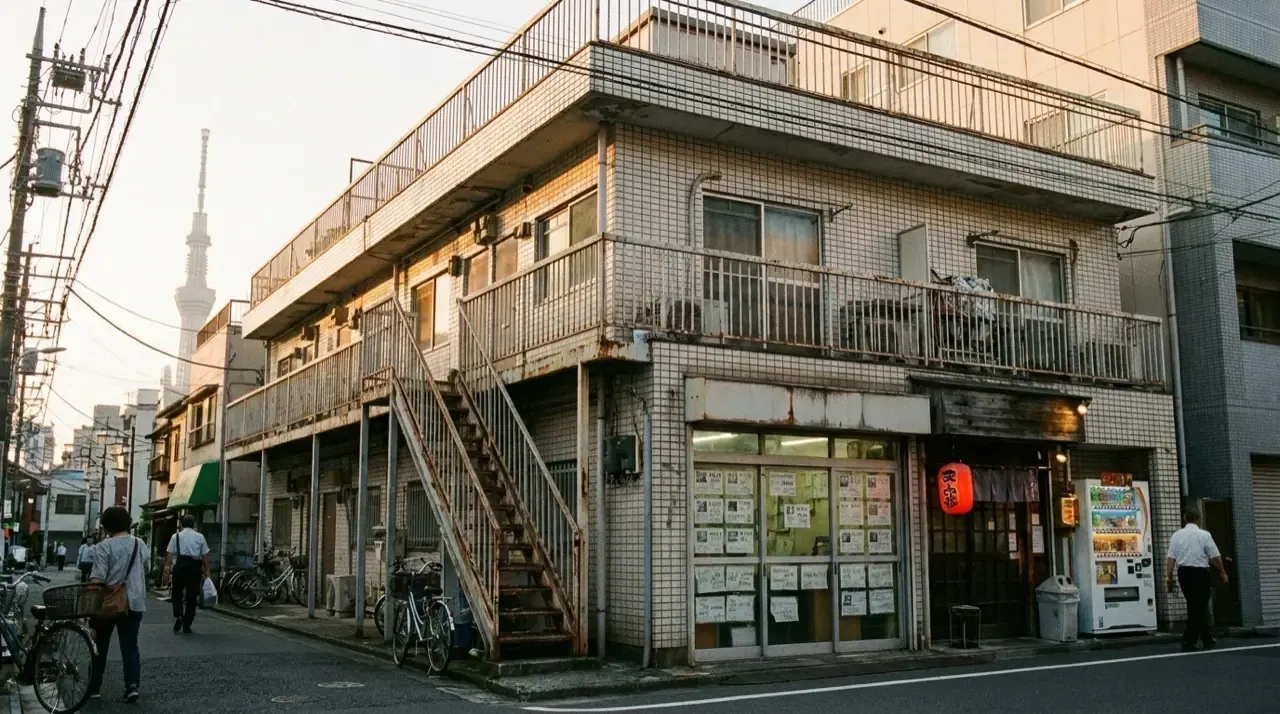
I found the listing on a Tuesday at 11pm, which is when I did most of my apartment hunting during my first Tokyo relocation because the good ones disappeared by noon. Three stops from Shibuya on the Den-en-toshi line, top floor, corner unit, south-facing windows. Monthly rent: ¥145,000. The note in the remarks column: nihonjin gentei.
Japanese only.
I screenshotted it anyway. Called the agency the next morning. The agent’s response was careful: “Oana de wa chotto muzukashii to omoimasu ga…” — It might be a little difficult, but… I asked if she could inquire. She did. The answer came back within an hour: the landlord was willing to discuss it if I could bring a Japanese guarantor.
I had a Japanese guarantor. I got the apartment.
That experience taught me something I’ve since confirmed working in this market for years: “Japanese only” is a starting position, not a final answer. At least sometimes.
What “Japanese Only” Actually Says on the Page
The phrasing varies. You’ll see:
- Nihonjin gentei — Japanese persons only
- Gaikokujin fuka — Foreigners not permitted
- “Those capable of communicating in Japanese” — stated in Japanese
- Guarantee company required, with screening (not explicit, but often a soft code)
The last one matters. Many listings don’t say “Japanese only” at all — they just require guarantee company screening, and the guarantee company does the filtering. The discrimination is real but invisible in the language.
The explicit phrases are, at minimum, honest about where you stand before you spend time and application fees.
From the desk — In years of running foreign applicants past landlords, the pattern I keep seeing is that the ones who say ‘Japanese only’ loudest are usually individual owners burned once by a single tenant — any nationality — and overcorrecting; the corporate-managed buildings I submit to almost never blink at the same applicant, because they’re reading a checklist, not a memory.
Related reading: How I Passed Rental Tenant Screening as a Foreigner on My Third Try.
The Three Distinct Fears Behind One Phrase
Start with why the fear exists at all. Japanese lease law heavily favors the tenant. Evicting someone — even for non-payment — can take over a year through the courts. Landlords have almost no tools for early termination. They also have almost no way to communicate with a tenant who doesn’t speak Japanese, which means if something goes wrong — a noise complaint, a water leak, renewal paperwork — the breakdown happens in silence until it becomes a problem. A landlord signing a 2-year lease with a foreigner is also signing up for 2 years of potential miscommunication. Most landlords aren’t property developers with legal teams. They’re individuals who own one building, maybe inherited it, and have no bandwidth for complexity. That’s the structural part. Legitimate, addressable.
When I’ve had the opportunity to talk directly with landlords who use “Japanese only” language — sometimes while helping a foreign client through a deal — they articulate different concerns, and they’re worth separating.
Fear 1: Communication failure. The most commonly stated reason and the one most amenable to solutions. Landlords and their management companies worry about emergency notifications (fire, flood, earthquake procedures), lease renewal paperwork, neighbor complaints landing at the management office with no way to relay them, and move-out inspection disputes when nobody can agree what the contract says. Demonstrate Japanese-language competence and this fear can often be directly addressed. If you have JLPT N2 or higher, say so explicitly — in your application, on the main form, in the notes section if there is one. If you don’t have formal certification, a cover letter from a Japanese employer vouching for your communication level can substitute. Some properties now route applications through foreigner-specialist agencies (gaikokujin-muke chintai) who handle the communication layer: the landlord signs a contract with the agency, not you directly. Increasingly common in central Tokyo.
Fear 2: Unknown customs around shared spaces. Almost never stated explicitly but you can feel it underneath. Concerns about noise, garbage sorting, shoe removal, attitudes toward neighbors. Sounds minor. Shared-wall buildings with thin walls and communal garbage areas are genuinely fragile ecosystems. Landlords with bad memories of one difficult tenant — any nationality — sometimes overcorrect.
Fear 3: Visa uncertainty and transience. If your visa ends and you disappear, the landlord may have a unit sitting empty mid-lease with no easy recourse. Structural concern tied to immigration law, not your individual character. Some landlords have genuinely been burned by this. Underneath it sits a broader assumption: landlords think foreigners leave. Statistically not unfounded — Japan has historically had higher churn among foreign residents — but it flattens individual situations into a demographic proxy. Demonstrating tenure intent helps. Things that move the needle: a job contract with no fixed end date (or at least 2+ years remaining); school enrollment for children at a local school; a Japanese partner or spouse; prior rental history in Japan — ideally 3+ years with the same landlord; a letter from your company confirming they intend to maintain your Japan posting. None of these are silver bullets. All of them help.
The category determines the strategy.
Related reading: The Remote-Landlord Stack: How to Own and Run a Tokyo Rental From 8,000 Miles Away.
The Part That Is Discrimination
Some rejections are straightforwardly ethnic. Not language-based. Not documentation-based. Just: this person’s name doesn’t look Japanese and I don’t want them in my building.
I’ve seen application forms where the landlord’s “preferred profile” was written in pencil in the margin of the agent’s notes. I’ve watched an agent laugh nervously when I asked why a property that had been vacant for four months was suddenly “already taken” the morning after my application went in.
Japan has no enforceable federal anti-discrimination housing law equivalent to the U.S. Fair Housing Act. The 2016 Act for the Promotion of Smooth Rental Housing for Foreigners is a guidance document, not a penalty framework. Landlords face almost no legal consequence for rejecting a foreign applicant.
Some of it is racism. Name-recognition, assumption of transience, assumption of lifestyle difference. That set of rejections is not your target market. You cannot fix that landlord. Move on faster.
When “Japanese Only” Is Actually Negotiable
Not every “Japanese only” listing has a landlord who will move on it. But some will, given specific conditions:
Permanent residency holders. PR is treated almost identically to Japanese national status by most landlords and guarantee companies. If you hold PR and a listing says “Japanese only,” it’s worth the inquiry. Many landlords don’t know what PR means — a brief explanation from your agent often resolves it.
Long-term residents with documented history. Five or more years in Japan, stable employment, prior rental history, and ideally a previous Japanese landlord willing to provide a reference. Strong package.
Properties with vacancies over three months. A landlord who’s turned away six applicants for a 3-month-empty unit starts having different conversations. Vacancy is expensive. Your agent knows how long a property has sat. Use that information.
Buildings managed by corporate management companies, not individual owners. Corporate managers tend to apply rules more uniformly and are more accustomed to reviewing exceptions. Individual owners are more variable — they can be more prejudiced, or more flexible, depending on the person.
The Buildings That Don’t Say “Japanese Only” But Effectively Are
The cleaner discrimination is often invisible, and most of it runs through the guarantor layer.
Old system: you needed a Japanese personal guarantor (rentai hoshounin). New system: almost everyone uses a corporate guarantee company (hosho gaisha). Theoretically neutral, right? Not quite. Guarantee companies run their own screening. And several of the major ones — Cosmos Initia, Casa, INTAGE — have different risk parameters for foreign nationals. Specifically, they look at:
- Visa type and remaining duration
- Whether the visa is renewable (permanent resident vs. student vs. work visa tied to a specific employer)
- Employment stability (company size, years employed)
- Whether the employer is a recognized Japanese entity
Someone on a spouse visa with a Japanese partner who’s employed has a reasonable approval path. Someone on a 1-year engineer visa at a startup with 15 employees will face heavy scrutiny or flat rejection from the same guarantee company.
So a listing with no restriction language gets submitted by your agent. The agent comes back and says the guarantee company declined. The agent does not suggest trying a different guarantee company. The agent does not ask the landlord to consider a different guarantee structure. You get one “no” and move on. The guarantee company rejects, the agent tells you the landlord rejected. You never know which. It’s all reported as one “no.”
Nobody said “Japanese only.” The effect is the same.
From the desk — In years of running applications for foreign clients, the rejection I see most often isn’t the landlord at all; it’s the guarantee company quietly declining on visa type, and the agent relaying it back as a flat landlord no. The buyers who eventually stopped fighting the rental gatekeeper and priced out owning instead were almost always the ones who’d been turned down two or three times for reasons nobody would name to their face.
Worth knowing not to generate outrage but to generate strategy. Ask your agent directly: “Is the rejection from the guarantee company or the landlord?” Ask: “Can we try a different guarantee company?” Ask: “Would the landlord accept a larger security deposit or a different guarantor structure?” Most agents will not ask these questions on your behalf unless you prompt them.
Related reading: Key Money (Reikin): The ¥0-Return Gift to Your Landlord, and How to Avoid It.
Where to Find Landlords Who’ve Said Yes Before
Foreigner-specialist agencies maintain inventory where the landlord has already agreed to the arrangement. Sakura House, Fontaine, Kaguya, Global Housing Tokyo, Toei Housing — all curate portfolios where “foreigner” isn’t a variable. Smaller selection. Much higher acceptance rate.
Listings marked “gaikokujin-ka” (foreigners accepted). Beyond that, Relocation Japan also maintains a curated foreign-friendly portfolio. The trade-off is sometimes price and location.
Corporate buildings managed by large real estate companies — Nomura Real Estate, Mitsui Fudosan Residential, Tokyu Housing Lease, and major operators like Leopalace, Haseko Livenet, or Ken Corporation — apply written eligibility criteria that are applied more mechanically and less subjectively than older buildings with individual owner-operators. Less discretion, more predictability.
Maison-type 1LDK and larger units. Anecdotally, larger apartments have fewer “Japanese only” restrictions, possibly because the target tenant is already assumed to be a professional with income documentation, regardless of nationality.
Listings on bilingual platforms. SUUMO in English, GaijinPot Apartments, HousingJapan, and Spacemarket all self-select toward landlords with some tolerance or preference for international tenants.
Where This Goes Wrong
- Assuming “Japanese only” is always a hard wall. The inquire-anyway strategy works often enough that defaulting to no-attempt is leaving options off the table.
- Using a Japanese-only agent who doesn’t want the awkwardness of advocating for a foreign applicant. Your agent’s comfort level with pushing back is as important as the landlord’s initial stance.
- Getting angry at the agent who delivers bad news. The agent is usually not the decision maker. Anger burns a relationship you need.
- Not having a counter-offer ready. “What if I offer two months’ security deposit instead of one?” is a tangible move. “This seems unfair” is not.
- Submitting applications with no supporting narrative. The form alone doesn’t give landlords context. A brief Japanese-language cover letter explaining who you are and why you want this specific apartment changes the feel of the application.
- Underselling income stability. If your annual income is around ¥6 million but you’re paid partly in equity or bonuses, the base salary figure on your withholding tax certificate might look weak. Get ahead of this with documentation.
- Not having a move-in date that works for the landlord. A landlord trying to fill a unit by end of month isn’t rejecting your nationality when they pass on your “anytime in the next 3 months” application. Flexibility on timing is underrated.
- Applying at peak season (February–March) when landlords have market power. April is when foreign applicants get the most leverage — landlords who haven’t filled units by then are motivated.
FAQ
Q: Is “Japanese only” legal in Japan? Technically, there is guidance against discriminatory restrictions in rental housing, but no penalty mechanism. The Ministry of Land, Infrastructure, Transport and Tourism has requested that real estate associations discourage the practice. In practice, enforcement is voluntary. Some portals have stopped displaying “Japanese only” language, but the underlying decisions by landlords haven’t changed.
Q: Should I just not mention I’m a foreigner? Your nationality appears on your application (you’ll submit a copy of your residence card). You can’t hide it. Some people with Japanese citizenship by naturalization don’t face this issue — but if you’re on any visa, it’s visible in the documentation.
Q: Can I negotiate around a “Japanese only” restriction without my agent’s help? Not easily. The landlord’s point of contact is the listing agency, not you. Contacting the landlord directly is both unusual and likely to backfire. Work through an agent — ideally one with foreign-tenant experience.
Q: Is offering more rent effective? Rarely. Landlords who restrict to Japanese applicants based on communication or custom concerns usually aren’t doing price-risk math. More money doesn’t address what they’re afraid of. Documentation and a strong guarantor structure do.
Q: What if I have a Japanese spouse? Changes the calculus significantly for most landlords. If your spouse is the primary lease signatory with you as co-tenant, many “Japanese only” landlords will accept the arrangement. Have your agent present it clearly as such. It does not guarantee approval — but the guarantor situation becomes cleaner, the communication risk is perceived as lower, and the transience assumption softens.
Q: Can I find out the real reason I was rejected? Rarely. Agents are legally permitted to say “the landlord declined” and leave it there. You can ask, but most agents won’t press the landlord on your behalf. Working with a specialist agency, they may have a contact who’ll give you more detail informally.
Q: Do I need a Japanese guarantor at all anymore? For most listings, no — a corporate guarantee company has replaced the personal guarantor requirement. But some landlords still want both.
Q: If a guarantee company rejects me, can I try a different one? Yes. Multiple guarantee companies serve the Tokyo market, and their criteria differ. Your agent can theoretically request a different company. Most won’t volunteer this option — you have to ask.
Next issue: The guarantor system — how it works, what it costs, and why I’ve stood on both sides of it. The mechanics nobody explains until it’s too late.
The buyer’s angle
And notice who these walls are built for: renters. ‘Japanese only’ is a landlord’s filter on tenants. Landlords screen tenants; nobody screens an owner. Buy your own apartment and the listing that would have rejected you as a tenant is simply yours — you are the counterparty, not the applicant. If the rental side is wearing you down, that’s usually the clearest signal it’s time to price out owning instead — where most of these barriers simply don’t apply. See the buying track and run the numbers in our tools.