INSIDER TAKE
Tokyo vs the World: What $1 Million Actually Buys in 8 Global Cities
We walked $1M through 8 global cities. The Tokyo number will make you do a double-take — and the yield might change how you think about property.
On this page 10
- The Global $1M Property Comparison
- Why Tokyo Is Priced Like This (And Why That Might Not Last)
- What the $1M Apartment Actually Looks Like in Tokyo
- The Yield Picture: Cash Flow Exists Here
- Like-for-like against the gateway club
- Financing Is the Multiplier, and It Only Works in Tokyo
- The Entry Tax Nobody Advertises
- The Catch with the Cheap Option
- How to Act on the Gap
- FAQ
TL;DR: $1 million buys you a closet in Hong Kong, a parking spot in London, and — in Tokyo — a 60-something square meter apartment in a legitimate urban neighborhood, cash-flowing at 4-5% gross yield, with a foreigner-friendly title deed and no ongoing wealth tax. Stack near-zero-rate financing and friction-free freehold ownership for foreigners on top, and the spread versus a New York, London or Hong Kong condo becomes the whole investment case. That gap is not noise. It is the story.
Open any global real estate index. London, Sydney, Singapore — the price charts point the same direction: up, steeply, relentlessly. Then you get to Tokyo. The line barely moves. For a city of 14 million people, the capital of the world’s third-largest economy, that flatness feels like a misprint. It is not. It is a structural feature — and it is exactly why globally mobile capital is starting to pay attention.
So let us run the exercise properly. One million US dollars. Eight cities. What does it actually buy?
The Global $1M Property Comparison
The figures below are directional and illustrative — drawn from publicly available market data as of mid-2026 and rounded deliberately. Real estate prices move. Use these for orientation, not for offers.
| City | Approx. price/sqm (USD) | What $1M gets you | Typical gross rental yield |
|---|---|---|---|
| Tokyo | ~$8,000–$11,000 | ~65–80 sqm, 1LDK–2LDK, walkable inner ward | ~4–5% |
| New York | ~$15,000–$22,000 | ~40–55 sqm, outer borough or small Manhattan studio | ~3–4% |
| London | ~$17,000–$25,000 | ~35–50 sqm, outer Zone 2–3 | ~3–4% |
| Paris | ~$14,000–$18,000 | ~50–65 sqm, arrondissements 11–20 | ~3–4% |
| Singapore | ~$20,000–$28,000 | ~35–45 sqm, outside prime districts | ~2.5–3.5% |
| Sydney | ~$13,000–$19,000 | ~45–60 sqm, inner suburbs | ~3–3.5% |
| Dubai | ~$4,000–$8,000 | ~100–180 sqm, newer outer districts | ~5–7% |
| Hong Kong | ~$28,000–$40,000 | ~25–35 sqm, New Territories or micro-flat | ~2–3% |
Tokyo sits in an unusual band: developed-world infrastructure, safety, and rule of law — paired with a price-per-sqm that looks like it belongs in a cheaper tier. Dubai beats it on raw yield and square footage, but Dubai carries currency risk, no long-run capital appreciation track record, and zero legal permanence for foreign ownership in the way Japan’s freehold system provides. Tokyo is the anomaly that actually makes sense once you dig in.
From the desk — When I run the same million through these cities for a client, the reaction to the Tokyo square-meterage is almost always disbelief followed by suspicion that something must be wrong with the building. The work I keep doing is reassuring people that the price isn’t a defect; it’s the management ledger and the station distance they should be scrutinizing, not the headline number.
Why Tokyo Is Priced Like This (And Why That Might Not Last)
Three structural reasons keep Tokyo affordable relative to its peers.
Supply actually exists. Japan’s building codes permit density. Tokyo constructs more housing units per year than the entire state of California. When supply responds to demand, prices do not spiral. Simple, but rare.
The asset has historically depreciated. Traditional Japanese property accounting treated wooden structures as depreciating to zero over 22 years. That psychology — buy land, ignore the building — kept a lid on resale prices for decades. Reinforced concrete condos are different, but the cultural pricing habit lingers.
Foreign buyers were not here. Until recently, the combination of language barriers, visa complexity, and a strong yen made Japan invisible on most investors’ radars. That is changing. Yen weakness since 2022 cut the USD price of Tokyo real estate by 30–40% in dollar terms even as yen prices held flat. A structural discount, delivered for free.
Whether this gap closes in 5 years or 15 is genuinely uncertain. But the direction of travel seems clear: Tokyo is being discovered.
What the $1M Apartment Actually Looks Like in Tokyo
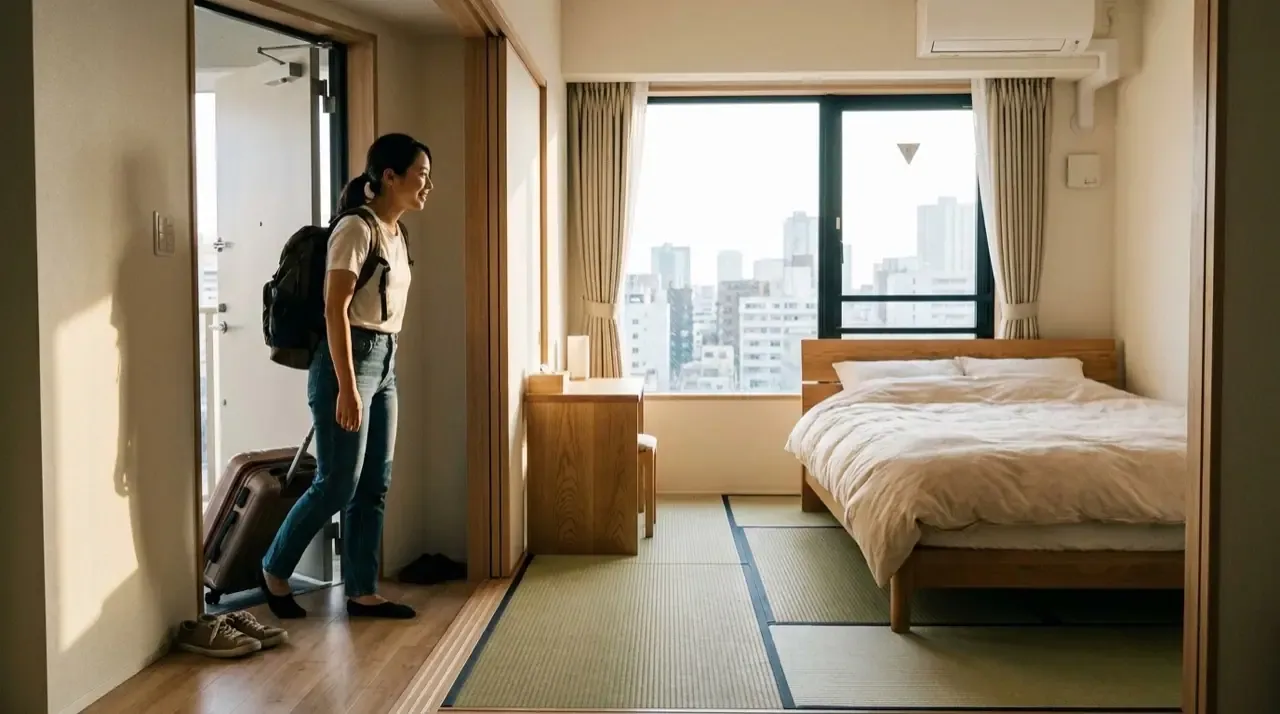
In a ward like Shibuya, Minato, or Shinjuku, a million dollars buys roughly a 65–75 sqm unit — call it a 1LDK or a compact 2LDK. That means a proper bedroom, a living area large enough for a dining table, a separate kitchen, and a bathroom that is not squeezed into a cupboard.
The building is likely reinforced concrete, earthquake-resistant to post-2000 code standards, with auto-locking entrance, 24-hour parcel boxes, and managed common areas. The nearest train station is probably a 5–10 minute walk. That train connects to central Tokyo in under 20 minutes.
Put the same million into central London and you are negotiating for a one-bedroom flat in Zone 2 with a service charge that makes you wince every January. Put it into Manhattan and you are likely compromising on neighborhood or size in ways that feel like a consolation prize.
Tokyo does not feel like a consolation prize.
The Yield Picture: Cash Flow Exists Here
Most global gateway cities punish investors on rental yield. You buy a status asset, you accept 2–3% gross, you pray for appreciation.
Tokyo is different. A 65 sqm unit in an inner ward, bought at $1M, rented to a working professional at market rates, will gross roughly $40,000–$50,000 per year. Net of management fees, property tax, and the occasional repair, you land around 3–4% net — which in 2026, against a backdrop of other gateway cities yielding 2.5% gross before costs, is quietly extraordinary.
The rental market is also structurally stable. Japan’s vacancy rate in central Tokyo stays low because new renters consistently absorb new supply. Tenants tend to stay. Long lease terms are standard. Eviction, when needed, follows a legal process — slow, but protected. For an investor sitting offshore, that predictability matters more than raw yield numbers.
Like-for-like against the gateway club
There is a short list of cities that global money treats as a permanent home: New York, London, Hong Kong, Singapore, Sydney, Tokyo. They share deep markets, rule of law, liquidity, and the kind of address that holds value through cycles. They also share a tax most buyers never name out loud: in nearly all of them, the privilege of owning in a tier-1 global city costs you most of your income. Tokyo is the exception — same club, same liquidity, same rule-of-law comfort, but it still hands you a cash yield the others abandoned.
Walk the pack on income. Central Tokyo residential runs roughly 3.3% to 4% gross; Tokyo proper sits around 3.3%, with Japan nationwide closer to 4.2% in early 2025 (directional, as of writing). That is the top of the gateway pack, and crucially it is high enough to cover costs and carry rather than just fund hope.
Manhattan and broader New York condo yields typically land around 2-3% net, with 3.5-4% net considered genuinely good (as of writing). A prime Tokyo unit can out-yield a comparable Manhattan one while costing a fraction per square meter, which means you are buying both more income and more building for your money. Hong Kong residential sits around 2.5-3.5% amid high prices and softening demand. Singapore prime runs roughly 2.8-3.1%, with suburban districts (the Outside Central Region, or OCR) stretching to 3.5-4%. Tokyo matches or beats Asia’s other two financial hubs on income, in the core, not the fringe.
London is the one number that looks competitive on paper and is not in practice. You will see London gross yields quoted around 5%-plus, but that headline is a city-wide blend; central prime London yields far less, and the capital growth story has stalled — London property and rent prices fell roughly 10% over 2015-2025 (directional). Sydney rounds out the picture: prime yields are thin at roughly 2.5-3%, paired with some of the world’s highest price-to-income ratios. Sydney did post solid recent rent growth, around +3.7% over a recent six-month window, but off a low yield base. Tokyo lets you have the rent growth without surrendering the entry yield to get it.
One honest caveat: gross yield is not net yield. Management, fixed property tax, building reserve fees and vacancy all shave the headline in every city, Tokyo in
Related reading: A 35-Year Yen Mortgage at 2% While the U.S. Pays 6.5%: Japan’s Last Cheap-Money Window.
cluded. The point is not that Tokyo is free money; it is that Tokyo starts the race several lengths ahead.
Financing Is the Multiplier, and It Only Works in Tokyo
Yield on the table is half the story. What you do with leverage is the other half, and this is where the gap stops being a few percentage points and becomes structural.
Positive leverage, the thing every property investor is actually chasing, only works when your borrowing cost is below your asset’s yield. In Tokyo, mortgage rates remain in the low single digits, comfortably under a 3.3-4% gross yield (directional). Borrow at well below the yield and every borrowed yen adds to your return rather than subtracting from it.
Run the same play in New York and it inverts. US mortgage rates around 6-7% sit well above a 2-3% net condo yield, so leverage is negative: every borrowed dollar costs you more than the asset earns, and you are effectively paying for the right to be levered. The same broken math afflicts most of the gateway peers. Tokyo is close to the only major global city where financing amplifies your return instead of eroding it.
That is the quiet reason a Tokyo deal can pencil for an overseas buyer when a nominally similar New York or London deal cannot. The yield gap you can see in the brochure widens dramatically once financing enters the picture, and financing is where most real returns are actually made or lost.
A caveat worth saying plainly: foreign-buyer mortgage access in Japan is real but not automatic; terms are best for buyers with Japan residency or an established banking relationship, and non-resident financing exists but is narrower. The rate environment is the edge; qualifying for it takes preparation.
The Entry Tax Nobody Advertises
Income and financing decide what you keep. Entry friction decides how much you surrender just to get in the door, and here Tokyo is almost embarrassingly clean.
Foreigners can buy freehold in Tokyo with no citizenship, residency or nationality requirement, and there is no foreign-buyer surcharge. You own the land and the building outright, on the same legal footing as a domestic buyer. That is rare.
Compare the rest of the club. Singapore layers an Additional Buyer’s Stamp Duty on foreigners that has reached roughly 60% of the purchase price, a number large enough to erase years of yield before you collect a single dollar of rent. Hong Kong and Sydney both impose foreign-buyer duties that meaningfully tax your entry. Same global-city tier, far heavier drag at the threshold. In Singapore’s case, a 60% ABSD does not just trim your return; it changes whether the investment is viable at all.
Stack the three layers and the case writes itself: Tokyo gives you the highest income in the pack, financing that actually works in your favor, and the lowest friction to walk in as a foreigner. The others typically give you one of those at best.
The honest caveat: low entry friction is not zero cost. Japan still has acquisition tax, registration fees, annual fixed-asset tax, and agent commission, and the tax treatment of your rental income depends on your home country and residency. Friction-free entry means no penalty for being foreign, not no transaction costs at all.
The Catch with the Cheap Option
Being honest about this matters.
Buildings age. Japan’s condominium management system requires reserve fund contributions, but not all buildings are well-managed. Older buildings — particularly those from the 1970s and 80s — may have underfunded reserves and upcoming major repair costs. Due diligence on the building’s management records (kanri kumiai documents) is non-negotiable.
The language barrier is real. All contracts, all disclosures, all agent communications default to Japanese. You need either fluency, a trusted bilingual agent, or a very good lawyer. Skipping this step is how foreign buyers end up surprised.
Liquidity is lower than you expect. Tokyo real estate is not a stock. Selling can take months. The buyer pool for higher-priced units is narrower than in New York or London, where international demand is more established.
The yen adds currency risk. Your $1M entry price looks attractive today partly because the yen is weak. If the yen strengthens significantly before you exit, your dollar-denominated return compresses. This cuts both ways — yen appreciation would boost your return — but model both scenarios before committing.
None of these are deal-killers. They are the real costs of operating in a market that most global investors have not yet priced correctly. That mispricing is exactly the opportunity.
How to Act on the Gap
The gateway-city yield gap is not a forecast you are betting on; it is a present-tense fact about income, rates and tax that you can measure today. Three concrete moves to turn the thesis into a position:
First, price the gap for yourself. Take a Tokyo unit you would actually buy and put its gross yield next to a comparable New York, London or Hong Kong unit, then redo the comparison after financing. The after-financing number is the one that matters, and it is usually where Tokyo’s lead becomes decisive. Our tools can help you run the yield-versus-carry math before you talk to anyone.
Second, choose the ward deliberately, because “Tokyo” is not one market. Core central wards trade yield for prestige and stability; outer wards push yield higher for slightly more management. Walk the wards guide to match the trade-off to your goal, and use compare to weigh specific areas side by side. If a term like reikin (a non-refundable “key money” payment to the landlord at lease signing) is new to you, the glossary has it in plain English.
Third, line up financing before you fall in love with a unit. The low-rate edge is the single biggest lever in this whole argument, and it rewards buyers who arrive with their banking and residency story already in order.
FAQ
Can foreigners actually buy property in Tokyo with full ownership rights? Yes. Japan grants foreigners the same freehold ownership rights as Japanese nationals. There are no equity restrictions, no special approvals for most residential purchases, and no minimum stay requirements. You can buy, rent out, and sell without living in Japan.
Do I need to be in Japan to complete the purchase? No. With a properly executed power of attorney, a licensed judicial scrivener (shiho shoshi) can handle registration on your behalf. Most of the process can be run remotely, with your physical presence needed only for the signing appointment — or not at all with POA in place.
What are the ongoing costs of owning a Tokyo condo? Expect annual fixed-asset tax of roughly 0.3–1.0% of assessed value, monthly management fees (kanri-hi) of $100–$300 for most inner-ward condos, and repair reserve fund contributions. Property management for a rental runs around 5% of monthly rent. Total annual holding cost for a $1M unit typically sits in the $6,000–$12,000 range.
Is the rental market in Tokyo foreigner-friendly for landlords? Generally yes, though some older landlords still show reluctance to rent to foreign nationals — a prejudice that is slowly eroding. As a foreign owner renting to other expatriates or international tenants, you are operating in a well-worn niche with active professional property managers who specialize in exactly this.
How does Tokyo compare to Dubai for pure investment return? Dubai offers higher headline yields and larger square footage. But freehold title in Dubai applies only to specific designated zones, the legal framework for property owners is less tested than Japan’s, and capital gains on exit are less predictable. For investors who prioritize rule-of-law security alongside return, Tokyo’s lower yield is rational compensation for lower risk.
The gap between Tokyo’s price and its fundamentals is real. The question is how long it stays open.
If you want a Tokyo-based insider walking you through specific neighborhoods, numbers, and how to actually execute a purchase as a foreigner — this newsletter is the place to start.