INSIDER TAKE
The Land Underneath Is Compounding: How Tokyo's Skyline Rebuild Quietly Reprices Central Ground
In Japan the building depreciates toward zero, but the land compounds. Tokyo's five central wards are repricing dirt structurally faster than the rest of the city as trophy redevelopments, office and hotel demand, and office-to-housing conversion squeeze the same plots. Here is how a foreign buyer targets the land share that actually appreciates.
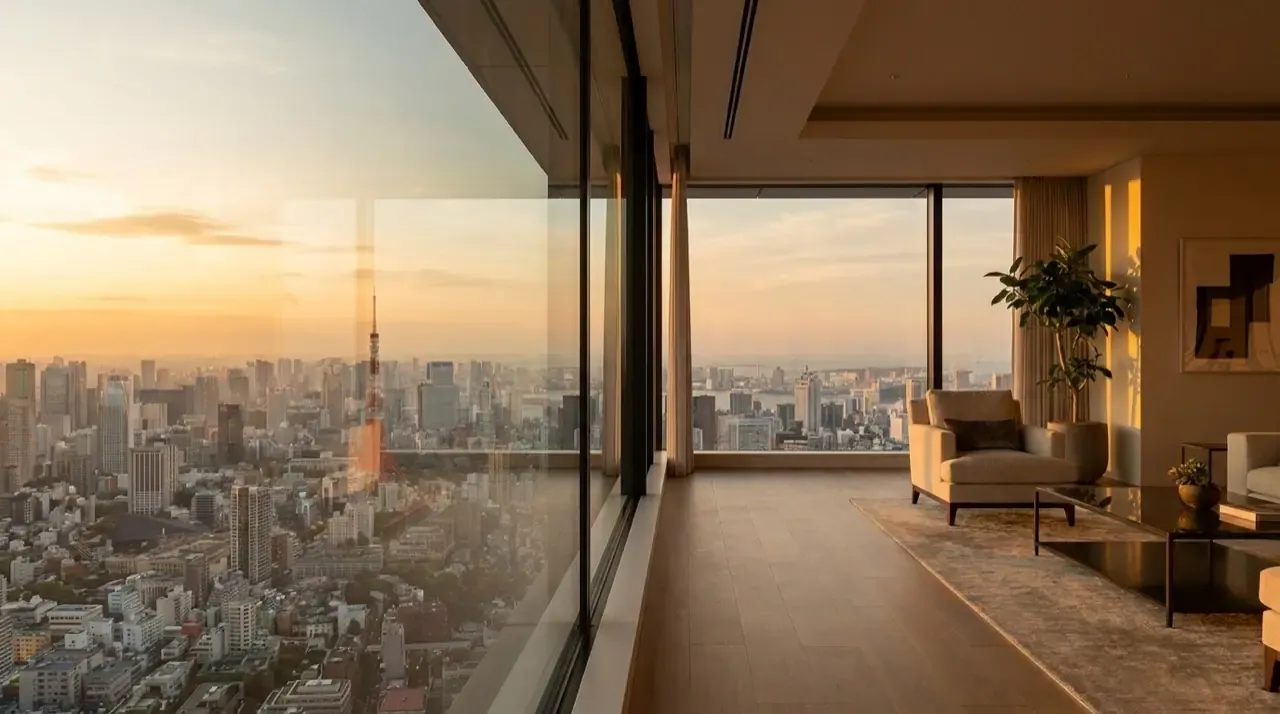
On this page 6
TL;DR: In Japan the building loses value toward zero on a fixed schedule, but the land underneath does the compounding, and central Tokyo’s land is being squeezed from three directions at once: trophy redevelopments, office and hotel demand competing for the same plots, and older offices being converted into housing. The five central wards are repricing land structurally faster than the rest of the city, and the gap is widening, not closing. For a foreign buyer, the asset that actually appreciates is the central-ward land share embedded in your unit, made permanently scarcer by the city’s own rebuild cycle.
The one rule that governs every Japanese property
Almost every mistake foreigners make in this market traces back to a single misread: they price the building and ignore the dirt. In Japan it works the other way around. The structure is a depreciating asset on a legislated clock, written down toward zero across its tax life. The land it sits on is not depreciated at all, because land does not wear out. Your condo is really two assets stapled together, one melting and one compounding, and over a long enough hold the land share is the only part that decides whether you made money.
This is why “the building is old” is a weak objection to a central purchase and a strong one to a suburban one. In a central ward, the land share embedded in your unit can be the dominant portion of value, so structural depreciation is a rounding error against ground that keeps repricing. Out in the periphery, where land is cheap and abundant, the depreciating box is most of what you bought. Same country, opposite outcomes, and the dividing line is how scarce the ground is. If you want one mental model for Tokyo, it is this: you are buying a land position with a building attached, not a building with some land thrown in.
From the desk — In the deals I’ve watched over the years, the foreign buyers who lose money are almost always the ones who fixated on how old the building was while ignoring how scarce the dirt under it had become. I keep telling clients near a funded redevelopment that they’re not buying a condo, they’re buying a land position the city is actively making harder to reproduce, and the ones who hold that ground rather than flipping it are the ones who quietly come out ahead.
Three forces squeezing central land at once
What makes the five central wards (Chiyoda, Chuo, Minato, Shinjuku, Shibuya) different is not vibes. It is that three separate mechanisms are pulling the same finite plots in the same direction.
First, trophy redevelopment. Projects like Azabudai, Toranomon, and Shibuya do not just add floor space; they re-rate an entire district. Azabudai Hills is a roughly 640bn yen (about 5.3bn dollars) project packing around 861,500 square meters of office, residential, and hotel onto roughly 8.1 hectares (as of 2023 completion). A single development like that flips a neighborhood’s identity from “place you work” to “place you want to live,” and the surrounding land gets repriced to the new identity.
Second, use competition. The highest-value uses, office, hotel, and luxury mixed-use, are bidding for the exact plots a condo developer needs. In 2025, central commercial land rose roughly 11.2 percent against about 5.6 percent for residential (directional, as of writing). When offices and hotels outbid housing for dirt, new central condo supply gets structurally choked before a single unit is drawn.
Third, conversion. Older, less competitive office buildings are increasingly being turned into housing. That sounds like new supply, and at the unit level it is, but it also confirms that central land is too valuable to leave underused, which only reinforces the floor under prices.
Honest caveat: these three forces are reinforcing today, but they are policy- and rate-sensitive. A sharp move in interest rates or a zoning shift could slow the pace. It changes the speed of the trend, not its direction.
Related reading: Tokyo’s Redevelopment Supercycle: Every Major Project, Mapped.
The gap between core and periphery is widening
Here is the number that matters most. In 2025, land prices in the central five wards rose roughly 12.0 percent, against about 7.4 percent for the other 18 wards (directional, based on official and standard land-price data). The core is compounding around 1.6 times faster than the periphery, and the spread is not a one-year blip. It is persistent, because the three forces above only operate where land is already scarce and already expensive.
Compounding gaps are unforgiving. A 1.6x faster annual rate, sustained, does not produce a 1.6x difference in outcomes; it pulls apart exponentially over a ten- or fifteen-year hold. This is the quiet engine behind the headlines. The trophy towers get the photos, but the real story is that owning central ground means sitting on the fast side of a widening divide while the depreciating building does its slow, predictable melt underneath you.
You do not need to time anything clever to capture this. You need to be on the correct side of the spread and hold. The mechanism does the work.
Redevelopment proximity is a measurable land-value mechanism
The link between a nearby rebuild and your land value is concrete, not a story you tell yourself. Look at Minato-ku resale prices in the Azabudai and Toranomon orbit, up roughly 3x over 2016 to 2025 (directional). That is the tower pulling the whole neighborhood, not just its own units.
Or take Futako-Tamagawa, a cleaner natural experiment outside the core. Land within roughly 200 meters of that station-area redevelopment rose about 44.9 percent, with a local population bump of around 6 percent (directional, illustrative). Proximity to a station-area rebuild is a land-value capture mechanism you can locate on a map, not a feeling.
And the hotspots cluster. Chuo-ku held 5 of the top-10 highest land-price-increase locations in 2025 (directional), tied to the Ginza, Tsukiji, and Shintomicho hotel and condo pipelines. Redevelopment does not lift everything evenly; it creates localized compounding pockets a buyer can deliberately target by buying near a confirmed, funded, station-adjacent project rather than chasing a ward average.
Caveat worth saying plainly: “near a redevelopment” only pays if the project is real and financed. A rumored plan is not a catalyst. Verify the pipeline before you pay for proximity.
The supply side is structurally choked, which favors today’s owners
The most bullish fact for anyone who already holds central ground is the one developers complain about most: they increasingly cannot secure central sites at all (as of writing). Office, hotel, and condo uses are fighting over the same dirt, so the plots needed to build new central housing are scarce, contested, and expensive before construction even begins.
For a foreign buyer this is the whole thesis in one sentence. The supply of new central housing is being throttled by the city’s own rebuild cycle, while demand to live in those re-rated districts keeps rising. Constrained supply meeting rising demand on a fixed quantity of land is the textbook setup for the land share to keep compounding. You are not betting on a building. You are buying a slice of a resource the market is actively making harder to reproduce.
The honest counterweight: this is a multi-year thesis, not a flip. Transaction costs in Japan are real, reikin (non-refundable “key money” paid to a landlord, relevant if you ever rent the unit out) and acquisition taxes among them, and the depreciating building does melt. Both are true and both are already priced into the long-land logic above.
How to actually act on this
Stop shopping for buildings and start shopping for land positions. Concretely:
- Weight the central five. Anchor your search in Chiyoda, Chuo, Minato, Shinjuku, and Shibuya, where the compounding spread is widest. Use the /wards pages to compare each ward’s profile before you narrow.
- Buy proximity to confirmed redevelopment. Target units near funded, station-adjacent projects, not rumored ones. The Futako-Tamagawa and Azabudai reads show proximity is measurable; make it a filter, not an afterthought.
- Estimate the land share, not the sticker price. On any unit you like, work out roughly how much of the price is land versus structure. A high land share in a central ward is the asset you want; a high structure share in the periphery is the one you do not. Our /tools can help you frame the math, and /compare lets you put two candidates side by side.
- Underwrite for a long hold. This thesis compounds over years. Price in transaction costs and building depreciation up front, then let the land do its job. New to the vocabulary, reikin, minpaku (short-term rental, often called Airbnb-style letting), and the rest, start with /glossary so the contracts read clearly.
The skyline you see going up across central Tokyo is not just new buildings. It is the city quietly making its own central land scarcer, plot by plot, and repricing the dirt under every nearby condo as it goes. Owning a central-ward land position is how you sit on the right side of that machine. The move is not to wait for the rebuild to finish. It is to buy the ground before the next tower confirms what it is worth.
Related reading: Tokyo Is Building Its Own Manhattan — One Trophy Tower at a Time.