WARDS & MARKETS
Shinagawa & Takanawa Gateway: Tokyo's New Southern Hub
JR East's Takanawa Gateway City is open and the maglev is coming to Shinagawa. Here is what the southern Tokyo transformation means for foreign buyers, and where the early-positioning money actually is.
On this page 7
TL;DR: Southern Tokyo is being rebuilt around Shinagawa into a global gateway: JR East’s Takanawa Gateway City is opening in phases, and Shinagawa will be the Tokyo terminus of the Chuo Shinkansen maglev. The catch is timing. The hardware is real and partly already standing; the maglev payoff has slipped to the mid-2030s. Buyers who understand which catalysts are near-term and which are far off can position before the rest of the market prices it all in.
Why Shinagawa, and why now
For decades Shinagawa was a place you passed through, not a place you bought into. It has the Tokaido Shinkansen, the Yamanote Line, a quick run to Haneda, and a big business district in Konan on the bay side. But it never had the prestige of Marunouchi or the polish of Roppongi. It was infrastructure, not address.
That is changing on purpose. JR East is repositioning itself from a railway into an urban developer, and Shinagawa is the centrepiece. The company is redeveloping what it calls the Greater Shinagawa Area, a corridor spanning five stations: Oimachi, Shinagawa, Takanawa Gateway, Tamachi and Hamamatsucho. The work is expected to run into the mid-2030s, and JR East is projecting more than 100 billion yen in revenue from it (directional, as of writing).
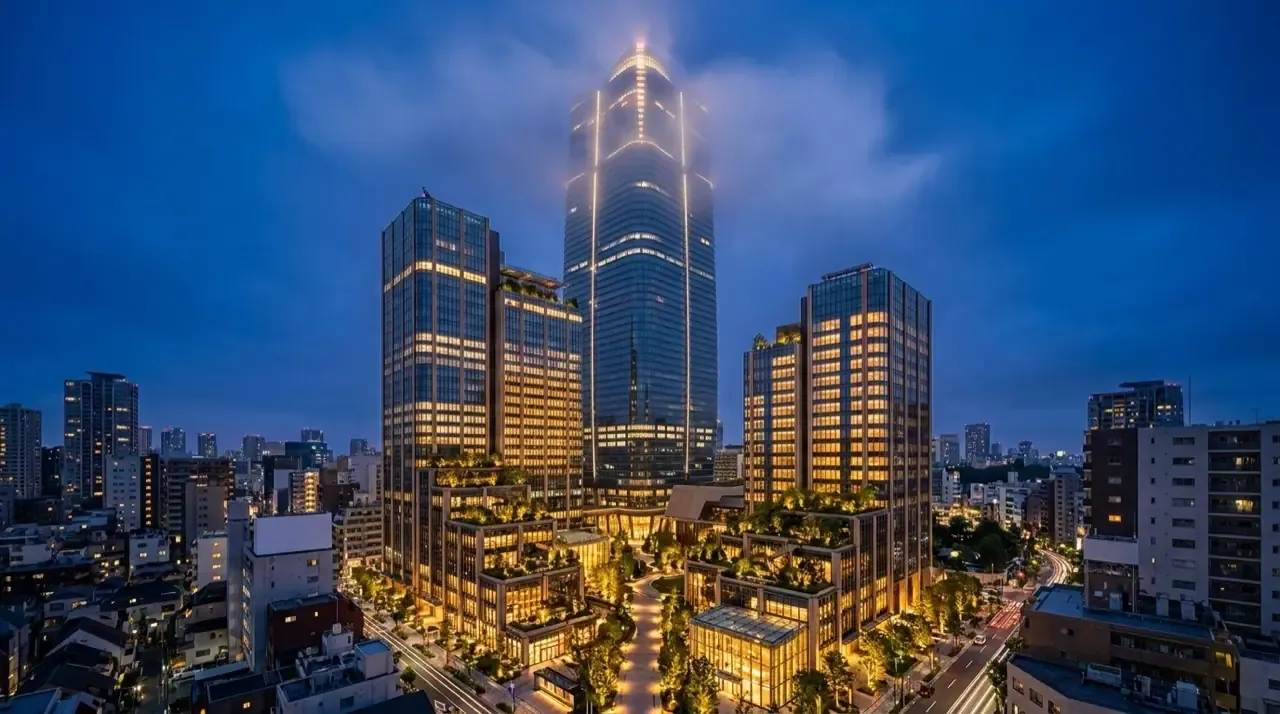
The headline piece is Takanawa Gateway City. The honest read: this is a once-in-a-generation reshaping of a part of central Tokyo that was, until recently, a rail yard.
From the desk — In a decade of closings around Shinagawa I keep seeing the same mistake: buyers chase the brand-new towers everyone already knows the name of, then balk at the older block two streets inland that shares the exact same station walk for noticeably less per meter. The ones who do best treat the maglev as a freebie they aren’t paying for, and underwrite only on the airport link and the new district that are actually landing this decade.
What Takanawa Gateway City actually is
This is not a single tower. It is a roughly 9.5-hectare district built on former railway land between Shinagawa and the new Takanawa Gateway station on the Yamanote Line, with total project investment in the range of 500 to 600 billion yen (directional, as of writing).
Phase one opened on 27 March 2025, anchored by the first of the development’s “Linkpillar” buildings. The remainder, including a second office-and-clinic tower, a cultural facility, and the residential component, is rolling out into 2026. When complete it includes:
- High-grade office space aimed at headquarters of major international firms, plus large convention facilities pitched at international conferences.
- NEWoMan Takanawa, a retail program of roughly 60,000 square meters and around 200 tenants, run by JR East’s LUMINE arm.
- A high-rise luxury hotel and a rooftop botanical space.
- Takanawa Gateway City Residence, with around 847 homes across the district when fully delivered (directional, as of writing).
- A campus for Tokyo International School, an IB school for ages 5 to 18, slated to open in August 2026.
That last point matters more than it looks. An international school inside the development is a magnet for exactly the tenant you want if you are a foreign buyer renting out: relocating executive families on housing allowances who need English-language schooling within walking distance. Supply of that combination in Tokyo is thin.
The maglev: huge, real, and later than advertised
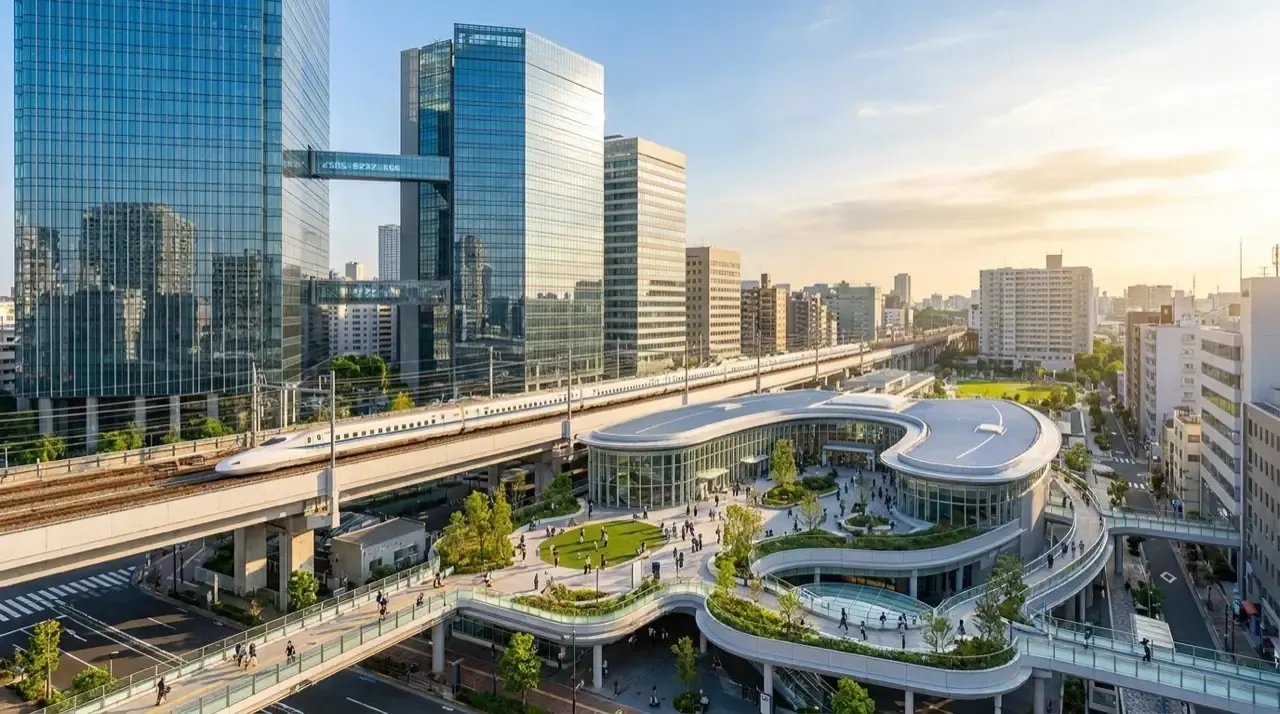
Shinagawa is the planned Tokyo terminus of the Chuo Shinkansen, the maglev line to Nagoya and eventually Osaka. The maglev station is being built below the existing Shinkansen platforms at Shinagawa, and tunnelling on the Tokyo end has been underway for years.
Here is the part you must not gloss over. The original target of opening Tokyo to Nagoya in 2027 is gone. JR Central has abandoned that date, and the line is now expected to open in the mid-2030s at the earliest, held up largely by a contested tunnel section in Shizuoka. Costs have roughly doubled from the original estimate to around 11 trillion yen (directional, as of writing).
So treat the maglev as a real but distant catalyst. If you are underwriting a purchase today on the assumption that a Shinagawa-to-Nagoya 40-minute maglev ride goes live in a couple of years, you are underwriting fiction. Underwrite the things that are actually arriving this decade instead.
Honest caveat: redevelopment timelines in Tokyo slip, and the maglev is the slippiest of them all. Build your numbers on the near-term catalysts; treat the maglev as upside you are not paying full price for.
Related reading: Chuo Ward Guide: Ginza, Nihonbashi & Tsukishima — Prestige vs Tower Liquidity.
The near-term catalysts that are actually arriving
Strip out the maglev hype and there is still a thick stack of concrete near-term drivers:
- Takanawa Gateway City completing through 2026 — offices, retail, hotel, residences and the school all landing within roughly two years, pulling daytime population, footfall and prestige into the area.
- The Haneda Airport Access Line, a new JR East rail link aiming to connect Tokyo Station to Haneda through the Greater Shinagawa corridor, targeted for around fiscal 2031 (directional, as of writing). For a global gateway, a faster airport link is worth more day-to-day than a maglev to Nagoya.
- Existing connectivity that already exists today: Tokaido Shinkansen, the Yamanote Line, and an airport that is minutes away.
In other words, the area’s value does not depend on the maglev arriving. The maglev is the call option on top.
What the price data is already telling you
The market is not waiting politely. In Japan’s 2026 official land price survey, the single highest rate of increase among residential points in Minato ward was 3-7-23 Konan, up 22.2% in one year (directional, as of writing). Konan is the bay-side district right at Shinagawa. That is the market voting on this corridor with real money.
Zoom out and the backdrop supports it. New condominiums across Tokyo’s 23 wards have been averaging well above 100 million yen, and Minato sits above that average, with prime central-ward pricing in the rough range of 2 to 4.5 million yen per square meter (directional, as of writing). Foreign participation is concentrated exactly here: in prime districts including Minato, foreign buyers have made up roughly 19% of activity, against around 13% across the rest of the 23 wards (directional, as of writing).
The implication for a foreign buyer: you are not early to the theme. You are, however, potentially early to specific pockets. Konan land has already moved hard. The question is whether the inland Takanawa side, and the secondhand stock a few minutes’ walk from the new district, has fully caught up. Often it has not, because the headlines focus on the shiny new towers.
How to position as a buyer
Three plays, in plain terms:
- Brand-new in the district. Takanawa Gateway City Residence and comparable new towers give you the cleanest story, the school, the retail, the prestige. You pay the most per square meter, and yields will be tight, in the low single digits typical of prime Minato. This is a capital-preservation and prestige play, not a yield play.
- Secondhand within a 10-minute walk. Older but well-located condominiums near Shinagawa, Takanawa and Konan let you buy the same connectivity and the same upside at a discount to the new towers. This is usually where the better risk-adjusted entry sits.
- The patient maglev option. If you genuinely have a mid-2030s horizon and the stomach for slippage, the maglev terminus thesis is intact and underpriced relative to where it will trade once an opening date firms up. Just size it as the long-dated bet it is.
Whichever you choose, run the actual numbers on yield, financing and the total cost of ownership before you fall in love with the map. Our tools page is built for exactly that, and the Minato ward profile goes deeper on the surrounding micro-markets. If you are weighing Shinagawa against another central district, compare them side by side rather than on vibes.
The bottom line
Shinagawa is being deliberately rebuilt into Tokyo’s southern gateway, and the near-term hardware, the new district, the retail, the school, the airport link, is real and arriving this decade. The maglev is the long-dated prize, not the reason to act now. The early-positioning edge is not in chasing the new towers everyone is already watching; it is in buying the well-connected stock around them before the corridor’s premium spreads from Konan land prices into the wider neighbourhood.
Your next step is concrete: pick one of the three plays above, pull comparable listings within a 10-minute walk of Shinagawa or Takanawa Gateway, and stress-test the yield and financing with our tools before the next phase opens. The map has already been drawn. Position on it while parts of it are still mispriced.